MusicHackspace Hackathon 2026 · Elk Audio Challenge · MUTEK Forum Montreal 2026
Crafting harmony is not the job of latent space.
THIRI bridges symbolic theory, discrete math, and physical acoustics: from chord symbols and roman numerals down to pitch classes and exact frequencies in Hz.
AI treats harmony as a probability distribution over audio waves. When models guess at chords in latent space, the result is predictable: chord hallucinations, clashing guide tones, and frozen audio stems that cannot be edited or steered.
Harmony is deterministic structure. It belongs to pitch-class sets, voice-leading rules, and mathematical ground truth. Call THIRI with the same input, and you get the identical, theory-correct musical decision every time.
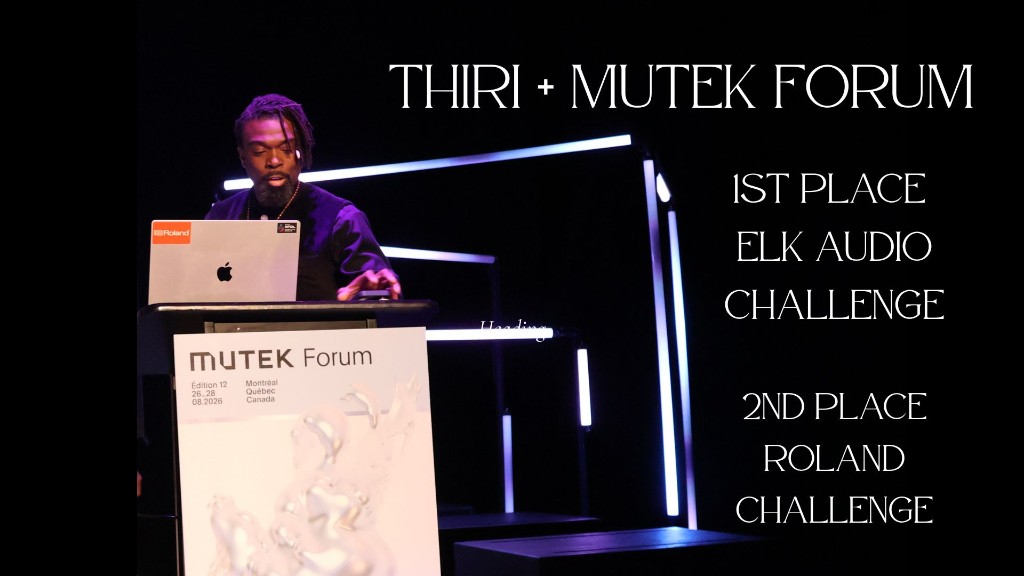
At MUTEK Forum Montreal, the Elk Audio Challenge asked whether that deterministic engine could survive inside a hard real-time 1.333 ms callback on a stock $399 Elk Stomp box without a server or an internet connection.
It does. 0.592 ms average. 5 voices. 1st place.
The headline measurement
| Metric | Measured value | Target / deadline | Hardware & environment |
|---|---|---|---|
| Average block latency | 0.592 ms | 1.333 ms deadline | Stock Elk Stomp ($399) · STM32MP157 (Cortex-A7 @ 800 MHz) |
| Worst-case peak | 0.788 ms | Zero xruns / dropouts | 48 kHz, 64-sample buffer, performance governor |
| Active polyphony | 5 voices | Headless JUCE 8 VST3 | Elk Audio OS 1.2.2 + Sushi 1.3.0 |
| Competition result | 1st place | Music Hackspace × MUTEK | August 22–23, 2026 · Montreal, QC |
Five surfaces, five numbers
Publishing numbers that matter for the developer, producer, and musician.
Five implementations of the deterministic harmony engine, ranked by verifiable benchmarks.
HORN SXTN on Elk Stomp
A looper that loops harmony, not just audio. Monophonic input; THIRI tracks chord-progression intent and renders moving 5-voice harmony on-device in hard real time. Proven on a stock $399 Elk Stomp. The pedal is not for sale.
THIRI MCP & Hosted API
A ground-truth theory rail over MCP and REST. Five tools: analyze, resolve, voicing, reharmonize, and conduct_band. Verified identical responses over stdio and hosted HTTPS.
Run the Changes
An endless runner on real engraved music notation. Players navigate real-time guide tones across 30 levels. 100% of chord spellings verified against the engine.
Roland Aerophone Audio/MIDI
Dual-VST architecture: MIDI for note intent and breath CC, line audio for envelope and timbre. Melody dictates harmonic resolution; breath modulates density.
Composer C
An agentic writing studio: plain English compiles into named p-fields. Closed-loop listen-back verifies required chord tones. Downloads run in vanilla Csound 6.x.
Game THIRI
A look at what's going on in music tech markets.
When there is a verified benchmark, an architectural break, or a shift in the music technology landscape, we write. Analysis of where generative audio hits structural limits, how agent protocols are reshaping DAWs, and market moves across music tech hardware and software.
- The complete Elk Stomp profiling teardown and thread-pinning data.
- Negative results and market post-mortems — including why audio-conditioned diffusion fails symbolic control.
- Weekly breakdowns of agentic audio, embedded DSP, and music AI infrastructure.